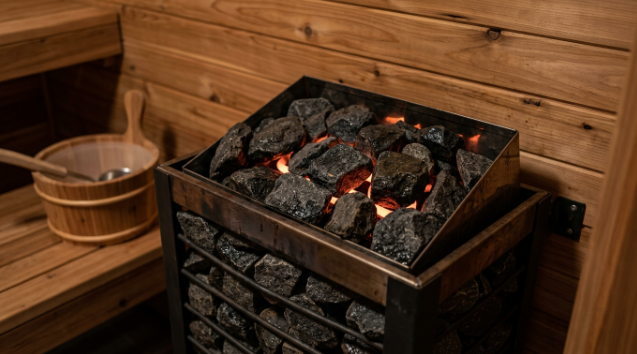
The heater that gets used by an entire household, not just the person who bought it, is sized for the largest realistic group (usually 8 to 10.5 kW for four to six people), controlled from outside the room with a digital panel, and quiet enough at startup that nobody avoids using it in the evening. A heater sized only for solo use often sits unused once a partner or teenager wants in, and an analog-only unit with no remote start becomes a coordination headache within the first month. Getting the sizing and control choice right up front matters more than any accessory added later.
How Does Household Size Change the Sizing Math?
A solo or two-person heater built for a 100 to 160 cubic foot cabin, typically 4.5 to 6 kW, is undersized the moment a third or fourth person wants to join a session. Cubic footage per person is the number that matters, since a crowded cabin adds body heat but also adds recovery time between door openings as people come and go. A household planning on regular multi-person use is generally better served sizing for the largest group that will realistically use the room together rather than the average, since an oversized heater that occasionally runs at partial output is a smaller problem than an undersized one that never reaches temperature once four people are inside.
See also: The Lifelong Value of Friendship and Community
Digital Control or Analog Dial: Which Fits a Shared Room?
An analog dial mounted on the heater itself requires walking into the room to change settings, which is a minor inconvenience for one regular user and an actual friction point across a household with different schedules. A digital control panel mounted outside the door solves two problems at once: it lets whoever is going first start preheating from the hallway, typically a 20 to 40 minute lead time depending on heater size, and its built-in timer, usually capped at 60 minutes, prevents the heater from being left running by a teenager who forgot about it. The price difference between the two control styles is modest compared to the heater itself, and households with more than two regular users tend to find it worth paying for.
What About Household Members With Different Heat Tolerance?
One heater sets one temperature for the room, so a partner who wants 190 degrees and another who is more comfortable at 150 cannot both get their preference in the same session. The practical compromise most multi-person households land on is a moderate setting in the 160 to 175 degree range, with heat-sensitive users taking shorter sessions or sitting on a lower bench where temperature runs several degrees cooler than near the ceiling. Some households solve this permanently by adding a second, smaller heater to a separate compact cabin rather than trying to satisfy everyone from a single unit, though that roughly doubles total project cost.
How Do Maintenance Needs Change With Heavier Household Use?
A heater used by one person a few times a week ages differently than one running daily for a family of four. Rocks crack faster under frequent water contact and should be checked every 6 to 12 months in a heavy-use household, with a full rock swap every 1 to 2 years rather than the 2 to 3 year interval a lighter, occasional user might get away with. The heating elements themselves generally last 5 to 10 years regardless of household size, but a unit run daily is worth inspecting for element discoloration or an uneven heat pattern sooner than a once-a-week cabin would need.
What Should a Household Compare Before Buying?
Beyond kilowatt rating, worth comparing across models are rock basket capacity (a larger basket, generally 70 pounds or more, holds heat longer between door openings, which matters more with frequent multi-person traffic), warranty length on the heating elements, and whether the control panel supports a preheat delay so the room is ready right when the first person wants it. Several household-focused reviews and current lineups, including shop the current options, break these specs out model by model, which is worth doing line by line rather than picking on kilowatt number alone. A heater that looks identical to a cheaper option on paper can differ meaningfully in basket size, element warranty, and control panel features that only matter once several people are sharing the same room.
Is Regular Household Sauna Use Backed by Evidence?
Research on regular sauna bathing is built mostly on Finnish cohort populations rather than households in other countries, so it should be read as a general association rather than a guarantee for any specific family. A 2023 review in Mayo Clinic Proceedings looked at whether combining sauna bathing with other lifestyle factors, like physical activity, produced additional benefits beyond either alone, finding the two appear to work together in the associations reported. An earlier review in the American Journal of Physiology covered the physiological effects of heat and cold exposure more broadly, including how the body adapts to repeated sauna sessions over time. A 2018 review in Mayo Clinic Proceedings summarized cardiovascular associations reported across the wider body of sauna research. None of this proves a specific household outcome, but it supports the general pattern that consistent, moderate use over years is the variable most associated with reported benefits, not any single long session.
How Does Cabin Layout Change for Multiple Regular Users?
A household planning on daily or near-daily use by more than two people often benefits from a two-tier bench layout rather than a single bench, since it lets a shorter session on the lower, cooler tier work for someone who wants less heat while another person takes a longer session up top. This is a design decision worth making before a cabin is built rather than retrofitted later, since adding a second bench tier after the fact usually means redoing wall paneling. Door placement matters too: a household with kids coming and going tends to lose more heat through frequent door openings than a single adult user would, which is a reasonable argument for sizing the heater toward the upper end of its cubic footage range rather than the minimum.
Storage for towels, robes, and rock supplies also becomes more of a factor once several people share one cabin regularly, since a single hook by the door works for one user but turns into clutter for four. A small bench or shelf just outside the cabin door, stocked with enough towels for the household’s typical group size, is a small addition that prevents a shared sauna from becoming a source of daily friction over who forgot to bring a towel.
Frequently Asked Questions
What heater output works for a family sauna? A cabin built for four to six people, generally 250 to 320 cubic feet, typically needs an 8 to 10.5 kW heater. A smaller unit usually means a longer preheat and constant full-output running.
Should a shared household sauna use a digital or analog control? Digital controls fit multi-user households better, since a remote panel with a timer lets preheating start from outside and prevents a heater being left running by accident.
Can two people use the same heater at different temperatures? Not in one session. Most households compromise on a moderate setting, take shorter sessions if heat-sensitive, or add a second smaller heater to a separate cabin.
How often does a shared heater need rock replacement? Check rocks every 6 to 12 months under daily household use, with a full replacement roughly every 1 to 2 years. Light use can stretch that closer to 3 years.
References
- Cardiovascular and Other Health Benefits of Sauna Bathing: A Review of the Evidence, Mayo Clinic Proceedings, 2018
- Does the Combination of Finnish Sauna Bathing and Other Lifestyle Factors Confer Additional Health Benefits? A Review of the Evidence, Mayo Clinic Proceedings, 2023
- Effects of heat and cold on health, with special reference to Finnish sauna bathing, American Journal of Physiology, 2018
By Melissa Chan