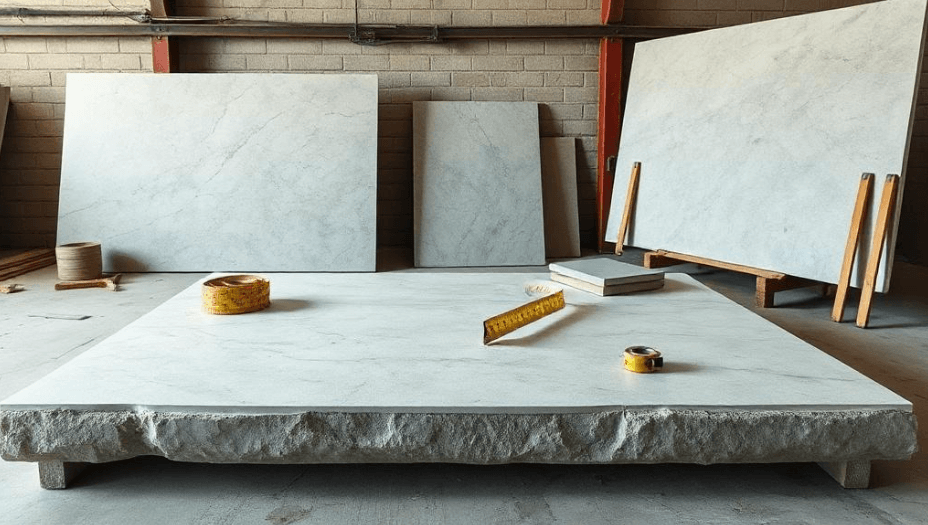
Good stone fabrication guidance around countertop slab material reference has to survive contact with dust, tape measures, rushed approvals, and expensive slabs. The value is accuracy, speed, and fewer callbacks.
Last March I was standing in a slab yard outside Boise with a customer named Rachel, watching her run her fingers across a bookmatched Calacatta quartzite. Beautiful slab. She wanted it for a kitchen island her family would use three meals a day, plus homework, plus wine nights. “This is the one,” she said. I asked if she knew what quartzite actually was. She said, “It’s like marble, right?” It’s not. It’s metamorphosed sandstone, Mohs 7 to 7.5, harder than granite. Marble is 3 to 5 on the same scale. That single conversation, the kind a salesperson either has or doesn’t, is the difference between a kitchen that holds up for fifteen years and a callback at eighteen months.
That’s what slab material knowledge really is. Not geology for the sake of geology. It’s the body of technical and commercial information a stone shop salesperson needs to recommend the right material, set realistic expectations, and avoid the phone calls nobody wants to make after install. It covers natural stone categories, engineered stone behavior under heat and impact, slab dimensions, porosity and sealing requirements, color consistency, and price tiers. Shops that document this knowledge in a single internal reference cut sales-floor disputes by up to 40 percent, based on trade case studies.
For homeowners, the practical takeaway is simple: two shops quoting the same slab at the same price can deliver very different finished kitchens. The difference is operational.
Quick reference points for 2026:
- Quartz slabs run roughly 56 by 120 inches in 2cm or 3cm thickness across major brands.
- Granite porosity varies from 0.4 to 1.5 percent by volume across common imports.
- Quartzite hardness: 7 to 7.5 Mohs. Granite: 6 to 6.5. Marble: 3 to 5.
- Engineered quartz heat tolerance generally caps at 300°F before resin damage occurs.
- Marble for residential kitchens commonly runs 3cm to avoid flex-related cracking.
The Gap Between What Customers Think and What the Stone Does
The core problem material knowledge solves is the mismatch between a customer’s mental model and production reality. People see a slab in a showroom and fall in love with the color. They almost never ask about porosity. They rarely know that “quartzite” and “quartz” are two completely different materials, one natural, one engineered. They don’t realize a high-movement veined slab won’t look the same after it’s cut, seamed, and installed across an L-shaped kitchen.
A shop that can’t bridge that gap at the sales counter will bridge it at the callback. And callbacks are expensive. Not just in labor (tear-out, refabrication, reinstall) but in reputation. One angry Google review about a cracked marble countertop can cost you ten kitchen jobs.
Shops with a documented, consistently trained material reference report up to 40 percent reduction in material-related callbacks. That number alone justifies the effort. But it also shows up in conversion: shops with disciplined material education report up to 14 percent improvement in showroom-to-quote conversion within twelve months. When a salesperson can walk a customer through the actual properties of a material, confidently and without hedging, the customer signs. It’s that boring and that effective.
What a Working Material Reference Actually Covers
A real shop-level material reference isn’t a glossy brochure. It’s a working document that covers six categories of information, each one tied to a decision point in the sales and fabrication process.
Stone categories. Granite, marble, quartzite, soapstone, travertine, and other natural stones, plus engineered quartz and porcelain. Each has its own production behavior, hardness profile, and price tier. A salesperson who can’t explain why soapstone scratches but self-heals (its talc content allows surface abrasions to be buffed with mineral oil) will lose credibility with a customer who did twenty minutes of YouTube research.
Dimensional standards. Slab size (roughly 56 by 120 inches in 2026), thickness (2cm or 3cm), and the tolerances you should expect from major suppliers. Knowing tolerances matters because a slab that’s 2.9cm on one end and 3.1cm on the other changes your fabrication plan.
Porosity and sealing. Every natural stone absorbs liquid at a different rate. Granite ranges from 0.4 to 1.5 percent porosity by volume. Marble can be higher. Sealing frequency runs annual to triennial depending on the stone. Engineered quartz requires no sealing. A customer who doesn’t hear this at the showroom will hear it from their contractor, and the version the contractor tells might not be accurate.
Heat and impact tolerance. Engineered quartz handles everyday cooking fine, but set a hot pan straight from the oven (above roughly 300°F) and the resin can scorch or crack. Natural stone handles heat better but can chip on impact, especially marble. These are the facts that prevent callbacks.
Color and pattern consistency. Engineered stone is batch-manufactured, so color variation between slabs is minor but real. Natural stone is, by definition, unique. Every slab is different. Customers who don’t understand this before they pick a high-movement quartzite or a dramatic veined marble will be disappointed at install, even if the fabrication is perfect.
Price tier. In 2026, installed costs per square foot run roughly: granite $38 to $115, quartz $55 to $130, quartzite $80 to $180, marble $60 to $200. These ranges reflect material, fabrication complexity, and regional labor. They’re useful for expectation-setting, not for quoting.
Owners building a real bench of operational reference material tend to keep a countertop slab material reference bookmarked alongside their working playbooks.
The Supply Chain You’re Actually Buying Into
Here’s something most homeowners never think about: roughly 78 percent of natural stone supply comes from four countries, Brazil, India, Turkey, and Italy. That means your granite is probably on a container ship for four to six weeks before it hits a distributor’s yard in the U.S. Supply disruptions (port strikes, quarry closures, container rate spikes) ripple through slab availability in ways that a showroom salesperson may or may not explain.
Major engineered quartz brands (Cambria, Silestone, MSI Q, Caesarstone, Cosentino) have more controlled supply chains but still face raw material and logistics variability. The practical implication for homeowners: if a shop says your slab is “in stock,” ask where. In their yard, or at a distributor three states away? That answer affects your timeline.
For shop owners, the supply chain question is about margin protection. Knowing which materials are readily available from local distributors versus special-order changes how you quote, how you set lead times, and how much risk you carry on a signed contract. This is the kind of operational intelligence that belongs in a material reference document, not in a salesperson’s head where it walks out the door when they take another job.
What Homeowners Should Actually Ask
Most homeowner advice about countertops focuses on aesthetics. Pick your color. Pick your edge profile. Visit the showroom. That’s fine, but it misses the operational questions that actually predict how your kitchen will turn out.
Ask about callback rate. A shop that tracks callbacks and can tell you their percentage is a shop that takes quality seriously. A shop that looks confused by the question is telling you something too.
Ask what software the shop runs for quoting and scheduling. Shops running modern fabrication software (Moraware, Actionflow, Slabsmith) are generally more organized than shops running everything off spreadsheets and whiteboards. Not always, but generally.
Ask how the shop handles templating. Digital templating (laser or photogrammetry) is more precise than manual templating. It matters for fit, especially on complex layouts.
Ask about sealing. If a shop tells you granite never needs sealing, that’s wrong. If they tell you engineered quartz needs sealing, that’s also wrong. Their answer to this question is a quick literacy test.
The boring truth is that these operational questions tell you more about your final kitchen than the showroom samples do.
Safety, Silica, and the Production Floor
Even if you’re a homeowner who will never set foot in a fabrication shop, you should know this: stone fabrication generates respirable crystalline silica dust on any cutting or grinding operation. OSHA 29 CFR 1926.1153 sets the permissible exposure limit at 50 micrograms per cubic meter as an 8-hour time-weighted average. This is a serious occupational hazard, and shops that take it seriously (wet cutting, proper ventilation, air monitoring) tend to take everything else seriously too.
Slabs themselves commonly weigh 600 to 900 pounds at 56 by 120 inches in 3cm thickness. Vacuum lift handling, forklift operation in slab yards, and manual handling of finished sections all fall under OSHA general industry standards. A well-run shop looks like a well-run shop the moment you walk in the door. If the yard is a mess and nobody’s wearing PPE, your kitchen project is in less capable hands than you’d like.
When to bring in outside expertise: Owners weighing major operational changes (platform purchases, equipment investments, multi-location expansion) commonly benefit from a trade-experienced consultant or shop peer review before committing capital. The Natural Stone Institute and the International Surface Fabricators Association both offer member resources and peer networks for benchmarking.
Building the Reference (And Why It Pays Back)
Implementing disciplined material knowledge at a typical residential shop runs in three phases over 60 to 90 days. Phase one is document creation: the owner or sales lead builds a single internal reference covering material categories, properties, dimensions, and price tiers. Phase two is salesperson training: each salesperson works through the reference, learns material differences, and practices common customer conversations. Phase three is customer-facing material: web content, showroom displays, and in-quote inserts that use the same language as the internal training.
The investment is real but modest. Typically 8 to 14 weeks of part-time work by the sales lead. The payback comes inside 12 to 18 months on conversion and callback improvements at typical residential volume. Vendor-supplied literature from Cambria, Silestone, or MSI is good for brand-specific content but doesn’t cover the broader category education customers need. Trade associations offer excellent starting material, but the shop-specific layer (your slab inventory, your pricing, your regional supply) has to come from you.
My honest opinion: the shops that don’t build this reference aren’t lazy. They’re busy. Fabrication is demanding work and documentation always feels like it can wait. But I’ve watched the same pattern play out a dozen times. The shop that documents its material knowledge keeps its salespeople longer, runs more consistent conversations, and closes at a higher rate. The shop that doesn’t keeps reinventing the wheel every time someone new joins the team. Pick which version you want to be.
Frequently Asked Questions
Q: How are slab dimensions standardized in 2026? A: Most quartz and granite slabs run roughly 56 by 120 inches in 2cm or 3cm thickness across major brands.
Q: What is the most popular countertop material in 2026? A: Engineered quartz remains the volume leader in residential work, with quartzite and porcelain growing fastest.
Q: How is granite priced compared to engineered quartz? A: Granite slab pricing in 2026 ranges roughly $38 to $115 per square foot installed; quartz commonly runs $55 to $130 installed.
Q: Why does quartzite cost more than granite? A: Quartzite is harder (Mohs 7 to 7.5) than granite (6 to 6.5) and is more demanding to fabricate, which raises shop-side labor cost.
Q: How heat-resistant is engineered quartz? A: Engineered quartz tolerates everyday cooking exposure but resin damage can occur above roughly 300°F.
Q: Do all natural stones need sealing? A: Yes, though frequency varies. Most natural stone requires sealing annually to every three years depending on porosity. Engineered quartz requires no sealing.
Q: How can a homeowner tell if a shop really knows its materials? A: Ask specific questions about porosity, heat tolerance, and sealing frequency. A knowledgeable shop will answer precisely, not vaguely. Ask about callback rate and templating method for additional signal.
Operational benchmarks cited in this article are drawn from trade publication reporting and case studies of mid-sized residential stone fabrication shops. Results vary by shop size, market, and operational discipline.